Adaptive Reuse in Architecture: How Industrial Spaces Become Healing Homes
The Kintsugi Loft | Adaptive Reuse
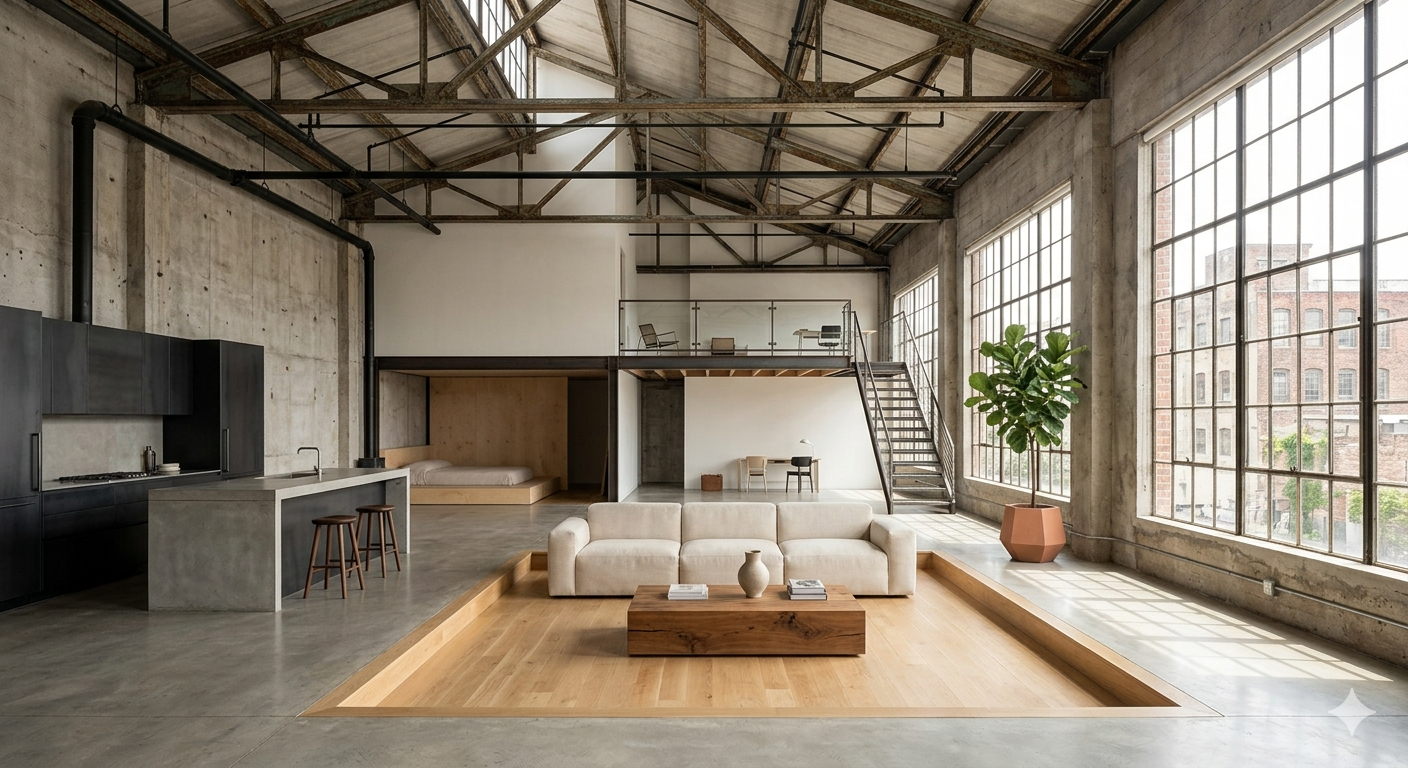
The Kintsugi Loft is a residential renovation project that transforms an abandoned manufacturing warehouse into a functional, multi-generational family home.
Inspired by the Japanese art of Kintsugi—repairing broken pottery with gold lacquer to highlight the cracks rather than hide them—this architectural intervention does not conceal the building's industrial past. Instead, the scars of the old concrete and steel structure are celebrated and integrated with warm, biophilic elements. It explores how we can repurpose the "broken" parts of our cities into spaces of healing and flourishing (Eudaimonia).
The Hook: Why Do Old Spaces Still Matter?
In a world driven by newness, demolition often feels like the default solution.
Old factories, warehouses, and industrial shells are seen as obsolete—
structures that no longer serve a purpose.
But what if their value isn’t in what they were…
but in what they can become?
Adaptive reuse challenges the idea that architecture must start from zero.
Instead, it asks a more complex question:
How do we design with memory?
The Philosophy: Kintsugi as an Architectural Framework
Kintsugi is not just a repair technique.
It’s a philosophy.
Rather than hiding imperfections, it reveals them.
Rather than replacing what is broken, it reinterprets it.
Applied to architecture, this mindset shifts the design process:
from erasing → to integrating
from perfection → to authenticity
from replacement → to transformation
The Kintsugi Loft becomes more than a renovation.
It becomes a dialogue between past and present.
The exposed concrete walls, weathered steel beams, and structural marks are not treated as flaws.
They are treated as evidence.
Evidence of time.
Of use.
Of history.
The Strategy: Adaptive Reuse as a Design Tool
Adaptive reuse is often framed as a sustainability strategy.
And it is.
But its real value goes beyond environmental impact.
It introduces constraints that generate creativity.
In the Kintsugi Loft, the original structure defines the possibilities:
column grids shape spatial organization
ceiling heights influence volume perception
material limitations guide aesthetic decisions
Instead of imposing a new identity, the design works with what already exists.
This results in spaces that feel:
grounded
honest
deeply contextual
The Science: Why These Spaces Feel Different
There’s a psychological dimension to adaptive reuse that often goes unnoticed.
Environments that combine:
natural materials
visible texture
layered history
tend to create a stronger emotional response.
Biophilic design plays a key role here.
By introducing:
natural light
vegetation
warm materials like wood
the project balances the hardness of concrete with elements that promote calm and well-being.
Research in environmental psychology suggests that:
exposure to natural elements reduces stress
textured environments increase cognitive engagement
spatial variety enhances comfort
The result is not just a functional home—
but a restorative environment.
The Design Moves: From Industrial to Intimate
Transforming a warehouse into a home requires more than subdivision.
It requires redefining scale.
Zoning Through Volume
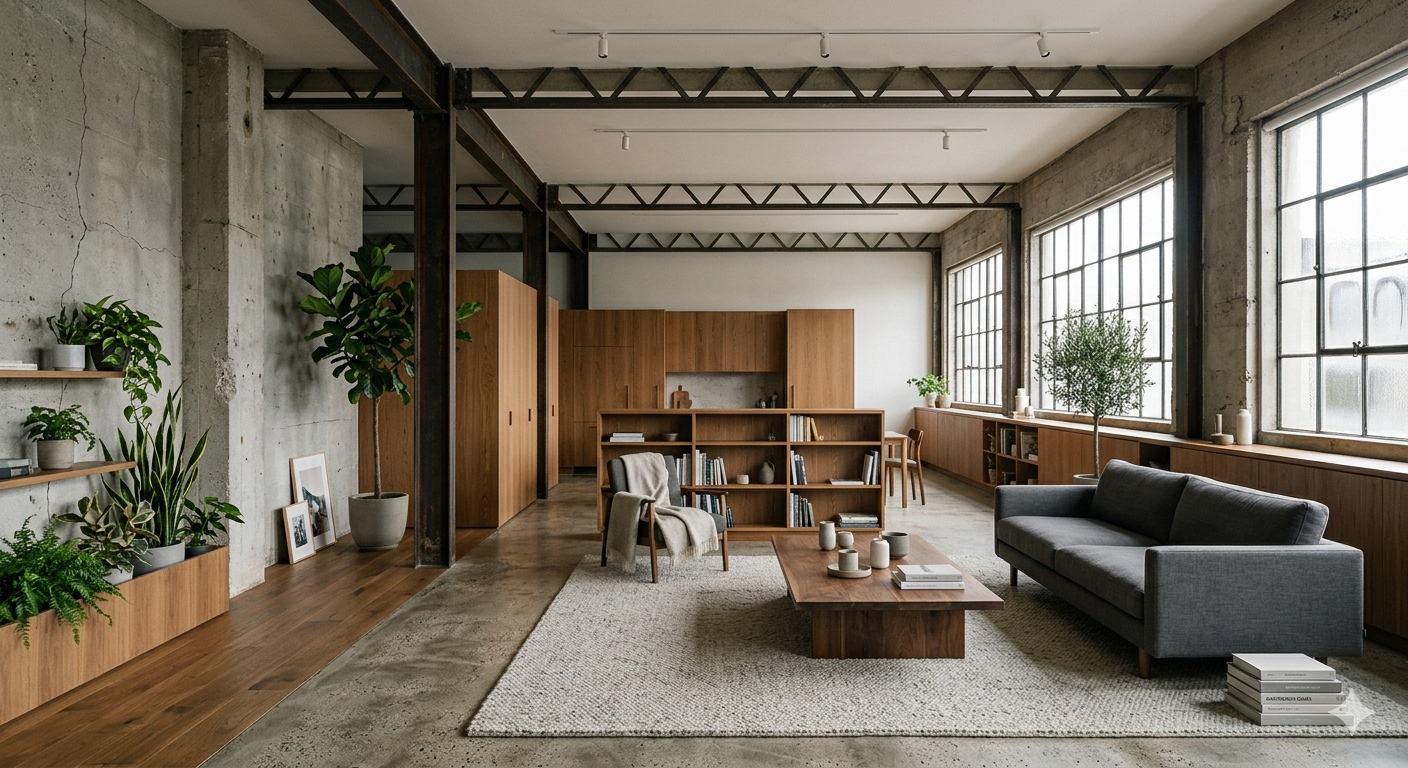
Instead of rigid walls, different ceiling heights and light conditions define spaces.
The Warm-Core Strategy
Private and social areas are anchored by warmer materials—wood, textiles, soft lighting.
Layering Old and New
New interventions are clearly distinguishable, yet complementary.
Nothing pretends to be original.
Nothing feels out of place.
Light as a Connector
Natural light is used to unify the space and soften industrial textures.
The Human Layer: Multi-Generational Living
The Kintsugi Loft is not just about space—
it’s about people.
Designing for a multi-generational family introduces complexity:
privacy vs connection
independence vs shared experience
Adaptive reuse naturally supports this dynamic.
Large, flexible spaces allow for:
evolving needs
shared moments
personal retreats
The architecture becomes adaptive not only in structure, but in use.
The Opportunity: Rethinking “Broken” Cities
Cities are full of underutilized structures.
Abandoned factories.
Empty warehouses.
Forgotten buildings.
They are often seen as problems.
But they are also opportunities.
Adaptive reuse reframes them as:
cultural assets
environmental solutions
architectural narratives
Instead of expanding outward, cities can evolve inward.
3 Practical Takeaways for Design Thinking
Work With Constraints
Limitations often lead to more meaningful solutions.
Embrace Imperfection
Texture, wear, and history create depth.
Design for Experience, Not Just Function
Spaces should support emotional well-being, not just efficiency.
The Risk: Romanticizing the Past
There is a fine line between honoring history and aestheticizing it.
Not every old structure should be preserved.
Not every imperfection adds value.
The challenge is to:
curate what remains
transform what doesn’t
balance memory with functionality
Conclusion: Architecture as Repair
The Kintsugi Loft is not just a project.
It’s a perspective.
It suggests that architecture doesn’t always need to build something new.
Sometimes, it needs to repair what already exists.
Not by hiding its past—
but by giving it a new meaning.
In doing so, it transforms not just spaces…
but the way we think about them.